Wednesday, 31 October 2007

Fly Away Home


Written by Eve Bunting and Illustrated by Ronald Himler

This is a story about a homeless boy who lives in an airport with his father, moving from terminal to terminal and trying not to be noticed, is given hope when he sees a trapped bird find its freedom.

1. As with any book, children are usually attracted to the cover. The cover is a selling feature of a lot of children's books. What do you think would be the reaction of the average child upon seeing the cover of this book?

2. From what point of view is the story being told?

3. Do you think the author successfully presented this very difficult topic? In what ways?

4. What is the significance of the bird?

5. Is this a story worth reading to children? Why? If not, explain your reasoning. Is it the story itself or do you think the subject-matter is too difficult?

Tuesday, 16 October 2007

Amazing Grace

(Written by Mary Hoffman and Illustrated by Caroline Birch)

Amazing Grace is a book not only about the power of imagination, but one with a clear message: anyone can do anything that they can put their minds to. This book also does a good job of pointing out the fact that in society, there are still preconceived ideas about who should do what. People often find it difficult to change.

1. Can you think of any instances where there are traditional expectations about specific roles and who should fill them? Give examples of any role or position in society that is filled in a stereotypical way.

2. What are the dangers about allowing children to believe that only certain people can fulfill certain roles and functions in society? What do you think the consequences may be?


3. Some would argue that it is irresponsible to allow children to think that they can do ANYTHING, so long as they put their minds to it. Do you agree or disagree with this statement? Explain your position. (It's alright if are sitting on the fence...)

Feel free to add any other comments you have on any of the issues that arise in this book.

Monday, 17 September 2007

Feedback

Hey!
I will be posting my feedback for all of your blogs here. Please read the comments so that your blogging can progress throughtout the semester.

Thursday, 16 August 2007

Book 4: Smoky Night


(Written by Eve Bunting and Illustrated by David Diaz)


The 1992 Los Angeles riots, also known as the Rodney King uprising or the Rodney King riots, were sparked on April 29, 1992 when a predominately white jury acquitted four police officers accused in the videotaped beating of black motorist Rodney King when he resisted arrest following a high-speed car chase. Thousands of blacks in the Los Angeles area joined in what is known as a race riot involving acts of law-breaking including looting, assault, arson and murder. In all, 53 people died during the riots.


1. Why would an author want to recount such a violent event in the format of a children's book?


2. What are the key social justice issues being addressed in the story?


3. Who are the unlikely heros in this story? What lesson do they teach everyone? Is it a universal lesson that all children can understand?

Book 3: The Best Worst Brother

(Written by Stephanie Stuve-Bodeen and Illustrated by Charlotte Fremaux)

Something tells me that very few of you were ever read this sort of story. It's only in recent time have children's authors felt it necessary to write about children with special needs.

1. What benefit could knowing about children with special needs bring to a child who does not have special needs?

2. Should parents openly talk about this topic in the home on a regular basis or as the need arises?

Book 2: Voices in the Park


(Written by Anthony Browne and Illustrated by Ian Butterworth)

This book is not as straight-forward as the last one. We are introduced to four voices that appear to be telling the same story...

They all go to the same park, but are their experiences the same?

Are they looking at the world in the same way?

What do you think is the purpose of the use of different fonts when a new voice is introduced to the story?

There doesn't really seem to be an ending to the story. What would be the purpose in reading this book?

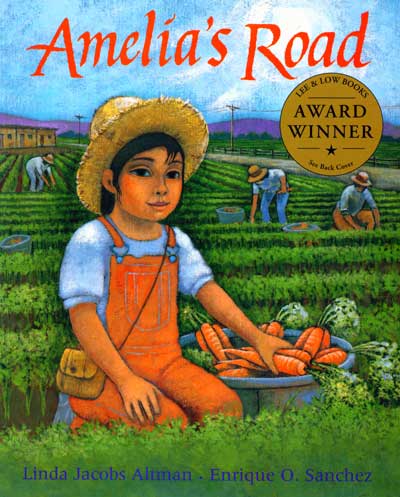
Book 1: Amelia's Road

(Written by Linda Jacobs Altman and Illustrated by Enrique O. Sanchez)

Admit it! You still love to be read to, don't you? I love this story. I was sitting in one of my Masters classes when our professor read this story to us and all of us went on this emotional rollercoaster with Amelia throughout the story.

What did you think of this book? In your response, feel free to include part of today's class discussion, as well as the following:

1. Why should children know about poverty? Shouldn't they be sheltered? After all, it is such an unpleasant topic...

2. Talk about the two teachers Amelia encounters in this story. How are they different?

3. What do you think is so important about Amelia's accidental road?

I really hope that you enjoy this story. Like all other children's books we will discuss this semester, it will be available in my classroom for you to look at as often as you wish.


Getting Started!

I firmly believe that a child truly misses out on a wonderful learning experience if he or she is not read to by their parent or caregiver. I also feel that children should be read meaningful literary pieces that help them to understand the world in which they live so that they can become more literate.

Each Friday, you will be introduced to a new children's book. Each book focuses on a specific issue. We will discuss the book in class, and then you will have the opportunity to express your thoughts, ideas and opinions about the book and what was discussed in class in this blog. You can discuss how the book made you personally feel, talk about the characters and how you might use this book to teach a child about the issue at hand. Discuss whether or not you like the book and if you would use it yourself. Feel free to discuss more than was just suggested.

A few things to note:
-blogging is mandatory
-refrain from offensive language or personal attacks on others or their ideas (it it totally
acceptable to disagree - and I hope debate arises - but you must do so in a way that
both your integrity as well as the person you address, whether directly or indirectly)

The plan is to book the computer lab on Fridays so that you can post your responses at school (I can't make any promises, and we have to be fair...). If you don't finish, it is your responsibility to complete your response on your own time. You can access this website from any computer in the school. I will check for your blogs on Monday. You will be assigned a mark out of 10 for each response. Failure to respond will result in a mark of zero.

I hope you enjoy this time during the week. I look forward to fabulous discussion and debate!